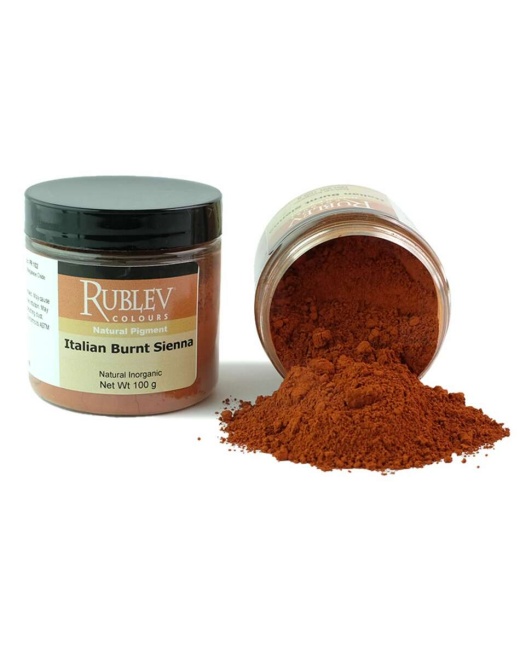
Burnt sienna is an iron oxide earth pigment that resembles red ocher. Unlike ochers, which generally are opaque, siennas are more translucent and warmer. When sienna earth is calcined (roasted) at high temperatures, it loses its water content (hydration), and it becomes burnt sienna.
| Pigment Names | |||
| Common Names: | English: burnt sienna French: terre de sienne brûlée German: Gebrannte Sienaerde Italian: terra di siena bruciata Russian: сиена жженая Spanish: tierra de siena tostada | ||
| Nomenclature: |
| ||
About Italian Burnt Sienna Origin of Burnt Sienna Pigment
The pigment now identified as burnt sienna is a calcined yellow iron oxide earth pigment generally warmer and more transparent than other yellow earth. In the scientific study of historical pigments, distinguishing yellow earth and siennas is not generally possible. Even in the case of modern pigments, there is often not a clear dividing line between yellow earth and raw sienna.
The pigment sienna owes its name to the Italian city Siena, located in the Tuscany region. An area of rolling hills, it has been famous for mining and producing sienna since the Renaissance. The localities where sienna earth is found are not confined to the original ones near Siena but are also found throughout Tuscany, Sicily, Sardinia, the Luberon Mountains in France, and the Harz Mountains of Germany; earth of similar quality is also found in these regions. In the United States, in Pennsylvania, deposits of sienna earth are found, and rich deposits have been developed in the mountain ranges of Virginia. In the European part of Russia, the most widely known sources of sienna earth are the Kudinovskoye deposit in the Moscow region and the Ukholovskoye deposit in Ryazan Province.
Natural earth and ocher have a rich history of application in both art and decoration, primarily due to their semi-transparent qualities. Artists across generations have favored these pigments for their unique ability to impart subtle, natural tones.
In Fine Art: These pigments have been indispensable to fine artists seeking a stable and versatile medium. Their semi-transparency allows for layering techniques that add depth and nuance to paintings. Although they do not produce strong tints when mixed with opaque materials like plaster, their soft undertones are prized for creating realistic and serene imagery.
In Architectural Beauty: An exemplary historical use of ocher is found in France, where they have been traditionally utilized in decorative coatings on buildings. The full spectrum of colors can be achieved through techniques such as fresco painting, which leverages the durability and resistance to fading of ocher. This ensured that structures retained their beauty and showcased a sophisticated interplay of colors over time.
Versatility and Longevity: Beyond their visual appeal, natural earth, and ocher are admired for their permanence and chemical stability, making them a staple in both artistic and architectural contexts. These qualities ensure that artworks and buildings decorated with these pigments maintain their integrity and continue to captivate audiences for centuries.
Source of Italian Burnt SiennaIron oxide earth pigments, often called, are an important group of inorganic pigments derived from minerals. Iron oxide pigments are available in yellow, red, and brown, but artists commonly refer to them as ocher, sienna, red oxide, and umber. Unlike manufactured pigments, the color of iron oxide earth pigments varies with the composition of the particular segment of earth from which they come. The color of sienna earth pigments is derived from three constituents: the principal coloring ingredient, a secondary coloring ingredient, and a base. The combination of these ingredients produces the particular color of the earth. The innumerable forms and variations in which these ingredients can combine result in a wide range of yellows, reds, and browns.
Principal Coloring IngredientIron oxide hydroxide is the principal color-producing ingredient in sienna earth. The properties of the particular iron oxide hydroxide in the earth determine its color. The nature of the iron oxide found in the deposit, rather than its percentage, is critical to the resulting earth color. Most rock contains some iron oxide. Those bearing the least amounts are limestone, white clay, and colorless kaolin. Those containing the highest amounts are the rocks from which metallic iron is extracted.
Secondary Coloring IngredientsCalcium, manganese oxide, carbonic materials, silica, and limestone are some common modifiers that affect the specific color of natural Sienna earth pigments. Manganese oxide, for example, enriches the brown in umbers.
BaseNearly all iron oxides have an alumina-silicate (clay) base. Clay is the weathered product of silicate rocks and exhibits a wide range of compositions. As a result, it has numerous effects on the earth’s color.
Natural sienna earth is a yellow pigment with a more or less brownish-red tinge in the mass tone and a more or less yellowish undertone. It differs from the yellow ocher by having a much deeper color, more than twice the tinting power, containing only two-fifths as much silica, only one-third as much alumina, and from two and one-half to three times as much iron oxide hydroxide, and in addition to this from one to one and one-half percent of manganese oxide, to the presence of which is due the color difference.
Natural sienna earth closely resembles yellow ocher by its composition. The content of iron oxide hydroxide in sienna varies from 40 to 70%, while in ocher, it may be less than 20%. A. H. Church reports the typical constituents of sienna based upon three analyses given by M. G. Hurst: Hygroscopic water 8.2 to 17.5%; combined water which includes traces of organic matter 9.0 to 12.4%; manganese dioxide 0.6 to 1.5%; iron oxide 45.8 to 59.7%; and silica 5.0 to 17.4% [The Chemistry of Paints and Painting, p. 230]. The differences in color between ocher and sienna earth pigments are most likely due to the degree of hydration or quantity of water bonded to its ferric oxide content. These pigments are composed of goethite and hematite, associated with varying proportions of mineral impurities.
Roasting natural sienna produces a significant change in its hue, as well as an increase in the depth of its color. The iron oxide hydroxide is converted to iron oxide, this change being accompanied by a significant increase in translucency and depth of color. Our Italian burnt sienna is roasted in furnaces from natural sienna extracted from deposits in northern Italy. It is especially noted for its rich reddish-brown color and transparency.
Italian Burnt Sienna Permanence, Lightfastness and CompatibilityBurnt sienna does not react with other pigments and is effectively used in fresco, oil, tempera, and watercolors. It is considered permanent, with medium tinting strength and excellent transparency. It does not react with solvents and is indifferent to alkalis but is partially soluble in acids.
Oil Absorption and GrindingBurnt sienna requires a large proportion of oil to produce a good oil-based paint. The oil absorption ratio is 45–55 parts by weight of oil to 100 parts by weight of linseed oil. If the measurement were grams, burnt sienna would require 45–55 grams (by weight) of linseed oil to grind 100 grams (by weight) of pigment to form a stiff paste.
Pigment Composition and SafetyBurnt Sienna is considered non-toxic, but care should always be exercised when handling the dry powder pigment to avoid inhaling the dust.
Rublev Colours Pigment: Italian Burnt Sienna Pigment
| Pigment Information | |
| Color: | Brown |
| Colour Index: | Pigment Red 102 (77491) |
| Chemical Name: | Iron Oxide |
| Chemical Name: | α-Fe2O3 |
| ASTM Lightfastness Rating | |
| Acrylic: | I |
| Oil: | I |
| Watercolor: | I |
| Properties | |
| Density: | 3.3–4.3 |
| Hardness: | 5.0–5.5 |
| Refractive Index: | nα=2.260 nβ=2.393 nγ=2.398 |
How to Use Burnt Sienna in Painting Determining Mixing Ratios for Burnt Sienna with Various Binders
If you’re aiming to mix Burnt Sienna with different binders, the key is to tailor the ratios based on the desired color intensity and application method. Here’s a concise guide to help you discover the perfect mix:
Understand the Basics- Pigment Characteristics: Burnt Sienna has a rich, earthy tone. Knowing its properties helps you predict how it will interact with different binders.
- Binder Selection: Common binders include linseed oil for oil paints, acrylic mediums for acrylics, egg yolk for egg tempera, and gum arabic for watercolors.
-
Identify Your Goals:
- Decide on the finish you want—opaque or translucent, matte or glossy.
-
Start with a Test Batch:
- Mix small amounts to see how the pigment reacts with each binder.
- Use a clean palette or mixing surface to maintain purity and test each binder separately.
-
Experiment with Ratios:
- For oil paints: Consider starting with a 1:2 ratio of binder to pigment, adjusting as needed.
- For acrylics: Try a 1:1 ratio, altering the mix for viscosity and color strength.
- For watercolors: Begin with a 1:2 ratio of pigment to gum arabic solution, adjusting for consistency.
-
Evaluate and Adjust:
- Test small swatches on paper o to ensure the desired effect.
- Allow the samples to dry to assess their final color and consistency.
- Adjust the ratios based on your observations—add more binder for a smoother finish or more pigment for a deeper color.
- Document Your Process: Keep a record of the ratios and results for future reference.
- Consider Environmental Factors: Temperature and humidity can affect drying times and color outcomes.
- Fine-Tune Consistently: Continually adjust based on both the binder properties and your creative preferences.
By experimenting with these guidelines, you’ll master the art of customizing Burnt Sienna mixes to suit any project.
How to Mix Burnt Sienna with Liquid BindersTo achieve the perfect consistency when mixing Burnt Sienna with liquid binders, follow this straightforward method:
-
Prepare Your Materials: Start by placing the Burnt Sienna pigment onto your slab.
-
Add Liquid Gradually: Introduce the liquid binder slowly; drop by drop is best for small amounts of pigment. The binder can be anything from linseed oil for oil paints to watercolor medium for watercolors and water for egg tempera, depending on your needs.
-
Mix Thoroughly: Use a palette knife or similar tool to blend the pigment with the liquid. Fold the pigment mixture until you achieve a smooth, consistent texture resembling a fine paste. This ensures that the color is even and ready for application.
By following these steps, you will create a seamless mixture that is ideal for your artistic projects, whether you are painting a canvas or working on a panel.
How to Mix Burnt Sienna with Dry BindersTo effectively mix Burnt Sienna with dry binders like plasters and cements, follow these steps for optimal color and texture:
-
Direct Mixing with Dry Ingredients:
- Begin by adding the Burnt Sienna pigment directly into your dry plaster or cement mixture.
- Ensure the pigment is evenly distributed throughout the dry components before you begin adding any liquid.
-
Creating a Pigment Dispersion (If necessary):
- If you notice clumping or uneven distribution—often referred to as micro-bursting—you may need to prepare a “color syrup.”
- Mix the Burnt Sienna pigment with a small amount of water to form a smooth, paste-like consistency.
- Gradually incorporate this syrup into the dry binder, ensuring an even color blend.
-
Proceeding with the Mixing Process:
- After achieving a uniform dry mix or integrating the color syrup, proceed to add the required amount of water or liquid binder.
- Stir thoroughly to ensure the color is consistently spread throughout the mixture, achieving the desired hue.
By following these steps, you can ensure the Burnt Sienna pigment is properly integrated into your plaster or cement, resulting in a rich and consistent color finish.
Essential Tools for Mixing Burnt SiennaWhen mixing Burnt Sienna, selecting the right tools is crucial for achieving the desired consistency, color, and depth. Here’s a guide to the tools you might consider:
-
Palette and Palette Knife: Ideal for smaller quantities of Burnt Sienna, a palette knife allows you to mix the pigment with a binder smoothly and evenly.
-
Mortar and Pestle: To reduce the particle size, use a mortar and pestle to grind the pigment.
-
Slab and Muller: Perfect for when your Burnt Sienna needs mulling to increase its smoothness and homogeneity. This combo allows for thorough mixing and is particularly useful in preparing artist-grade paints.
Each tool suits different needs based on the quantity of pigment and the texture required. Whether using a simple palette knife or advanced mechanical mixers, the right tool will help unlock Burnt Sienna’s full potential in your art projects.
Compare with Other Earth PigmentsWhen Burnt Sienna is mixed with white bases, its color undergoes a notable transformation. The once rich, earthy hue becomes significantly lighter and takes on an apricot-like tone. This color shift can vary depending on the amount of white added and the overall opacity of the mixture. The more white is introduced, the paler the tone will appear.
Why Can the Actual Pigment Color Differ from Its Digital Image?When viewing pigment colors on digital devices like computer monitors, tablets, or smartphones, there are a few key reasons why the shades might not perfectly match what you receive:
-
Screen Variability: Different devices have diverse display technologies. For instance, an Apple iPhone may display colors differently than a Samsung Galaxy due to variations in screen technologies and color settings.
-
Device Calibration: Many screens aren’t calibrated for color accuracy, which can lead to discrepancies. Even slight variations in settings, such as brightness or contrast, can alter color perception.
-
Lighting and Environment: The ambient light in the room, as viewed, can also impact how colors appear. A pigment may appear differently under natural light than under fluorescent lighting, which can alter what you see on screen.
-
Image Compression: Images displayed online may be compressed to load more quickly, which can potentially alter their color representation. Websites often sacrifice color precision for speed and performance.
These factors collectively contribute to why a pigment might appear slightly different in real life compared to its digital counterpart.