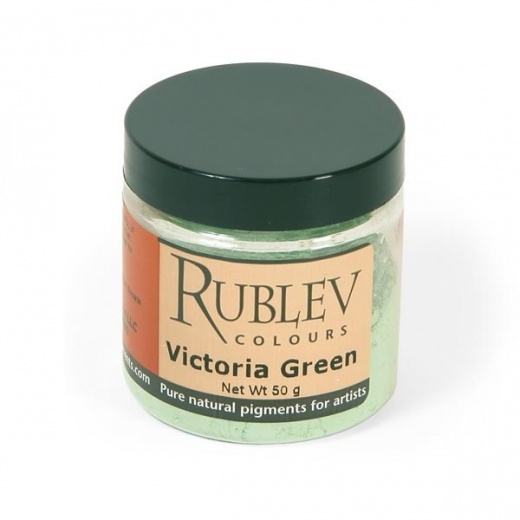
Victoria Green is a synthetic inorganic green pigment composed of a calcium chromium silicate matrix produced at high temperature for ceramic applications. The pigment yields a pale, slightly cool green color that is highly stable, permanent, and lightfast. Chromium is present in the trivalent state (Cr³⁺), chemically bound within a silicate lattice, contributing to the pigment’s exceptional durability and chemical inertness.
Victoria Green is compatible with all common painting media, including oil, watercolor, tempera, acrylic, and fresco. It exhibits excellent permanence and does not react adversely with other pigments.
| Pigment Names | |||||||
|---|---|---|---|---|---|---|---|
| Common Names: | English: Victoria green French: vert Victoria German: Victoria grün Italian: verde Victoria Spanish: Victoria verde | ||||||
| Synonyms: | English: Vernalis, Victoria green garnet | ||||||
| Nomenclature: |
| ||||||
| Pigment Information | |
|---|---|
| Color: | Green |
| Pigment Classification: | Synthetic Inorganic |
| Colour Index: | Pigment Green 51 (77300) |
| Chemical Name: | Calcium Chromium Silicate |
| Chemical Formula: | 3CaO•Cr2O3•3SiO2 |
| CAS No.: | 68553-01-5 |
| Series No.: | 7 |
| ASTM Lightfastness | |
| Acrylic: | Not Listed |
| Oil: | Not Listed (historically excellent) |
| Watercolor: | Not Listed (historically excellent) |
| Physical Properties | |
| Particle Size (mean): | 8 microns |
| Density: | Not reliably documented |
| Hardness: | Not reliably documented |
| Refractive Index: | Not reliably documented |
| Oil Absorption: | 25 grams oil / 100 grams pigment |
| Health and Safety | There are no acute or known chronic health hazards associated with the anticipated use of this product (most chemicals are not fully tested for chronic toxicity). Always protect yourself against potentially unknown chronic hazards of this and other chemical products by keeping them out of your body. Do this by avoiding ingestion, excessive skin contact, and inhalation of spraying mists, sanding dusts, and heating vapors. Conforms to ASTM D-4236. |
For a detailed explanation of the terms in the table above, please visit .
The origin of this pigment is obscure. The potter Sir William Burton introduced the pigment to the Society of Mural Decorators and Painters in Tempera in about 1900. The Society of Tempera Painters named the ceramic pigment Vernalis. Victoria green was the name designating a calcium chromium silicate pigment developed for use in ceramics. Artists’ paint manufacturers also used the name to designate a mixture of 80 parts of Viridian (Pigment Green 18), 40 parts of zinc yellow, and 10 parts of barite, gypsum, lithopone, or zinc oxide (Pigment White 4). Victoria green was sometimes called permanent green. However, the pigment described here is the true ceramic calcium chromium silicate, not a mixture. The Colour Index lists the green oxalate dye Victoria Green as Basic Green 4 (42000), but this is not the same as Rublev Colours Victoria Green.
SourceVictoria Green is produced by calcining chromium(III) oxide–bearing materials with silica (quartz) and calcium carbonate at high temperatures to form a stable calcium chromium silicate. Rublev Colours Victoria Green is manufactured according to traditional ceramic pigment formulations rather than modern mixed-pigment substitutes.
How Victoria Green Compares with Viridian (PG 18)Hue:
-
PG 51: pale, muted, slightly cool “chalky” green
-
PG 18 (Viridian): deeper, more transparent blue-green
Tinting strength:
-
PG 51: low–moderate (typically softer, more reserved)
-
PG 18: moderate (can dominate mixtures more readily than PG 51)
Transparency:
-
PG 51: typically semi-opaque to semi-transparent (often reads more “solid” in tints)
-
PG 18: transparent to semi-transparent
Handling and texture:
-
PG 51: can feel slightly more “mineral/ceramic,” giving soft, naturalistic mixtures
-
PG 18: smoother, clearer chroma, excels in glazing
Best uses:
-
PG 51: atmospheric greens, sage/lichen/stone-green notes, fresco passages, subdued landscape mixtures
-
PG 18: glazes, jewel-like cool greens, intense blue-green mixtures (with yellows for high-chroma greens)
-
If you want quiet, believable greens (foliage in distance, patina-like notes, greyed greens): start with PG 51.
-
If you want high-chroma greens or glazing greens, start with PG 18.
Victoria Green is lightfast and permanent. It is compatible with all pigments and with all vehicles, including fresco.
Oil Absorption and GrindingVictoria Green absorbs a medium amount of oil (25 g of oil per 100 g of pigment).
ToxicityVictoria Green is not considered toxic; however, care should be taken when handling the dry-powder pigment to avoid inhaling dust.
| Mixture Recipe Box for Victoria Green (PG 51) Guiding principle: PG 51 contributes structure and stability, not punch. Let other pigments set chroma; use PG 51 to quiet, mineralize, or naturalize the result. 1) PG 51 + Yellow Ochre (PY 43)Result: Natural foliage, sage, lichen green
Result: Cool grey-green, atmospheric green
Result: Olive, khaki, military greens
Result: Controlled chroma green with depth
Result: Chalky, mineral pastel greens
|