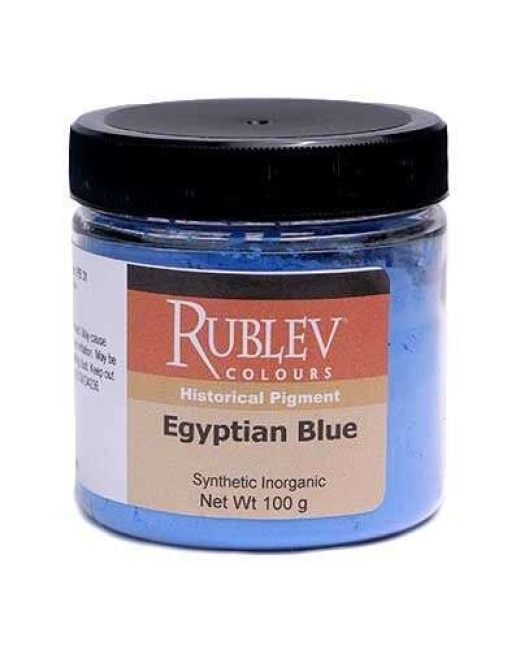
Egyptian Blue is a copper-calcium silicate that was the first synthetic pigment and the most widely used from the early dynasties in Egypt until the end of the Roman period in Europe.
| Pigment Names | |||||||
|---|---|---|---|---|---|---|---|
| Common Names: | English: Egyptian blue French: bleu Egyptien German: Ägyptisch Blau Italian: blu egiziano Russian: Египетская синь Spanish: azul egipcio | ||||||
| Historical Names: | English: blue frit, copper frit, Alexandrian blue, Pompeian blue, Pozzuoli blue, Vestorian blue French: bleu fritte, bleu d’Alexandrie, bleu de Pompeï, bleu de Pouzzoles German: Frittenblau Greek: kyanos Italian: azzuro egiziano Latin: caeruleum | ||||||
| Nomenclature: |
| ||||||
| Pigment Information | |
|---|---|
| Color: | Blue |
| Pigment Classification: | Synthetic Inorganic |
| Colour Index: | Pigment Blue 31 (77437) |
| Chemical Name: | Copper Calcium Silicate |
| Chemical Formula: | CaCuSi4O10 or CaOCuO(SiO2)4) |
| CAS No.: | 10279-60-4 |
| Series No.: | 7 |
| ASTM Lightfastness | |
| Acrylic: | Not Listed |
| Oil: | Not Listed |
| Watercolor: | Not Listed |
| Physical Properties | |
| Particle Size (mean): | 5 microns |
| Density: | 3.2–3.4 g/cm³ |
| Hardness: | 6 |
| Refractive Index: | α=1.636, β=1.591 |
| Oil Absorption: | 22 grams oil / 100 grams pigment |
| Health and Safety | There are no acute or known chronic health hazards associated with the anticipated use of this product (most chemicals are not fully tested for chronic toxicity). Always protect yourself against potentially unknown chronic hazards of this and other chemical products by keeping them out of your body. Do this by avoiding ingestion, excessive skin contact, and inhalation of spraying mists, sanding dusts, and vapors from heating. Conforms to ASTM D-4236. |
For a detailed explanation of the terms in the table above, please visit the page.
The invention of the process of manufacturing Egyptian blue during the first dynasties of ancient Egypt, beginning about 3100 B.C.E., was a consequence of other technical developments. It has been suggested that a blue frit was developed for use as a glaze and later as a powdered pigment.
SourceThe pigment Egyptian blue was always manufactured. The pigment is made by combining quartz, chalk (calcium carbonate), malachite (copper carbonate), and soda ash (sodium carbonate), then heating it to 900° to 1000° C.
Permanence and CompatibilityEgyptian blue is completely stable in all vehicles. It is completely lightfast. Egyptian blue was mixed with different pigments and used with lime on frescoes.
Oil Absorption and GrindingEgyptian blue absorbs a small amount of oil (22 g of oil per 100 g of pigment).
ToxicityEgyptian blue contains copper, which is considered toxic if inhaled or ingested over prolonged exposure. Care should be taken when handling the dry powder pigment to avoid inhaling dust.
strong>.