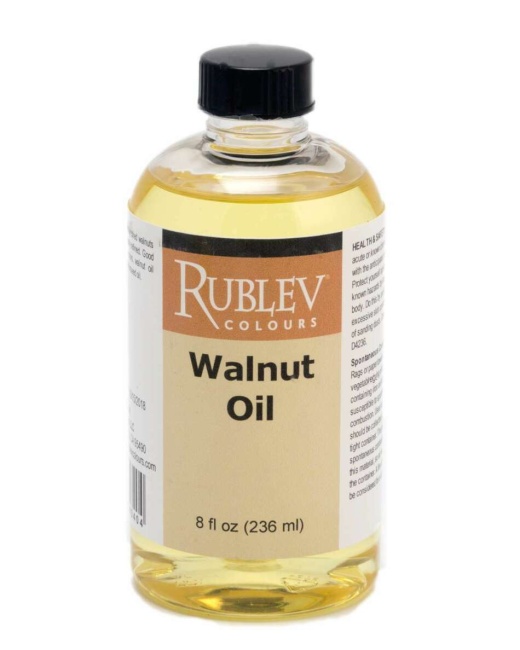
Our walnut oil is cold-pressed from freshly dried English walnuts (Juglans regia) grown in California and then lightly refined. It is a clear, pale yellow oil that is odorless. As a thin oil, it makes oil paint more fluid. As it yellows less than linseed oil (but more than safflower oil), it is suitable for making pale oil colors. Walnut oil dries more slowly than linseed oil, drying in four or five days. It is said to have a less tendency to crack than linseed oil, but research has not verified this.
UseThis oil is used to make oil colors and thin oil colors. It is excellent for making and thinning whites and pale colors.
Because of its safety and odor, some woodworkers prefer walnut oil as a finish for implements that come in contact with food, such as cutting boards and wooden bowls. People who formulate wood finish value walnut oil as an ingredient because of the edibility of both ingredients. The oil is typically combined with beeswax in a mixture of 1:2 oil to beeswax.
Turpentine, spike oil, or mineral spirits can be used as solvents for and brush and studio clean-up.
SourceWalnut oil is a pale yellow drying oil derived from freshly dried walnuts (Juglans regia). Most of the walnut oil sold in the United States of America is produced in California. There are also producers in France, Australia, and New Zealand. There are two types of walnut oil commercially available: cold-pressed and refined. Cold-pressed walnut oil is typically more expensive due to losing a higher percentage of the oil. Refined walnut oil is expeller pressed and may be saturated with a solvent to extract the highest percentage of oil in the nut meat. The solvent is subsequently eliminated by heating the mixture to around 200 °C (400 °F). Both methods produce food-grade oils. However, cold pressing preserves more nutrients and flavor—not crucial for use in paint.
HistoryAs early as the fifth century, Aetius recommended walnut oil for varnishing wax pictures and gilt surfaces. It is also recommended for all light pigments in the treatises on paintings by Leonardo da Vinci, Vasari, Borghini, Lornazzo, Armenini, Bisagno, Volpato, and others.
| Product Information | |
| Natural Source: | English Walnuts Juglans regia |
| CAS No.: | 84012-43-1/ 8024-09-7 |
| INCI Name: | Juglans Regia Seed Oil |
| Properties: | A pale yellow to golden yellow oil. It has a neutral odor and taste. It is insoluble in water. |
| Typical Fatty Acid Profile | |
| C16:0 Palmitic Acid: | 6.0 - 8.0% |
| C16:1 Palmitoleic Acid: | 0.5% maximum |
| C18:0 Stearic Acid: | 1.0 - 3.0% |
| C18:1 Oleic Acid: | 14.0 - 21.0% |
| C18:2 Linoleic Acid: | 54.0 - 65.0% |
| C18:3 Linolenic Acid: | 9.0 - 15.0% |
| Typical Fatty Acid Groups | |
| Free Fatty Acids: | 0.02% |
| Total Saturated Acids: | 10.1% |
| Total Mono-unsaturated Acids: | 16.7% |
| Total Polyunsaturated Acids: | 73.2% |
| Typical Physical and Chemical Properties | |
| Appearance: | Clear and Brilliant |
| Odor: | Odorless to slightly nutty odor |
| Refractive Index (at 20 °C.): | 1.474 – 1.478 |
| Color (Lovibond 5-1/4"): | 1.7 R 13.0 Y 0.0 B (Red: 1.7; Yellow: 13.0; Blue: 0.0) |
| Color (Gardner): | 2.1 |
| Acid Value: | 0.6 mg KOH/g maximum |
| Peroxide Value: | 5.0 meq/kg maximum |
| Specific Gravity (at 15 °C.): | 0.924–0.927 |
| Drying Index: | 86.6 |
No acute or known chronic health hazards are associated with this product's anticipated use (most chemicals are not thoroughly tested for chronic toxicity). Protect yourself against potentially unknown chronic hazards of this and other chemical products by keeping them out of your body. Do this by avoiding ingestion, excessive skin contact, and inhaling spraying mists, sanding dust, and vapors from heating. Conforms to ASTM D-4236.
WARNING: Rags or paper towels contaminated with vegetable drying oils, particularly those containing iron oxide pigments, are susceptible to spontaneous combustion. To prevent unexpected fires, used rags or paper towels contaminated with oil-based materials should be collected in a closable, air-tight container. Store water-dampened rags or paper towels in a metal container with an air-tight top. Alternatively, washing contaminated rags will remove contaminating materials and eliminate risk.
For more information on handling artists' materials safely, please read .
Residual SolventsIt complies with the guidelines GPMP/ICH/283/95 and CPMP/ICH/1940/00 corr. (residual solvents).
StorageFor best results, keep in well-closed, well-filled containers or under inert gas, protect from light, cool, and dry.
.
Frequently Asked Questions Can you oil out a painting with walnut oil?Yes, walnut oil can be used to oil out a painting. It helps in evening out the luster and deepening the colors. However, due to walnut oil's low viscosity, we recommend using higher viscosity bodied oils (stand oils) to improve hold out and restore gloss to severely matte paint surfaces.
Can I use food grade walnut oil for painting?While food grade walnut oil can be used for painting, artist-grade walnut oil is better suited for this purpose because it lacks additives, such as antioxidants, that may be added to food grade walnut oil to avoid rancidity and improve shelf life. Anti-oxidants should not be used in vegetable oils that are used in painting because they prevent film formation and hardening.
Is walnut oil better than linseed oil?Walnut oil dries slower and yellows less than linseed oil, making it preferable for certain painting techniques and colors.
What is the best oil to paint with?The best oil to paint with depends on the artist's preference and the desired outcome of the painting.
Did Da Vinci use walnut oil?There is historical evidence suggesting that Leonardo Da Vinci used walnut oil in his paintings.
Does walnut oil make oil paint dry faster?No, walnut oil generally dries slower than other drying oils used in painting.