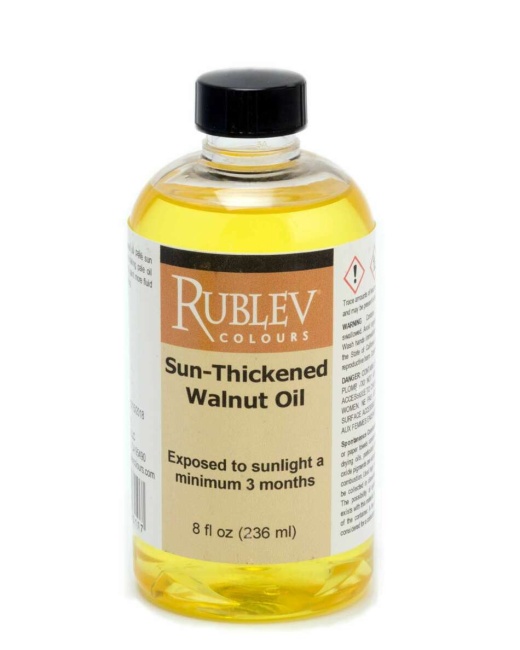
Rublev Colours Sun-Thickened Walnut Oil is made by exposing filtered, cold-pressed walnut oil to sunlight in shallow tanks covered with clear glass and exposed to the atmosphere for a period of at least three months. Exposure to sunlight thickens it. This walnut oil is naturally bleached to almost water white, so it can be used with palest colors and whites.
UseUse to make oil colors and thin oil colors. This oil is excellent for making and thinning whites and pale colors.
Some woodworkers prefer walnut oil as a finish for implements that come in contact with food, such as cutting boards and wooden bowls because of its safety. People who formulate wood finish value walnut oil as an ingredient because of the edibility of both ingredients. The oil typically is combined with beeswax in a mixture of 1:2 oil to beeswax.
Use turpentine, spike oil, or mineral spirits as the solvent for oil painting mediums and for brush and studio clean-up.
SourceWalnut oil is a pale yellow drying oil derived from freshly dried walnuts (Juglans regia) grown in California. Over 99% of walnut oil sold in the United States of America is produced in California. There are also producers in France, Australia, and New Zealand. There are two types of walnut oil commercially available: cold-pressed and refined. Cold-pressed walnut oil is typically more expensive due to the loss of a higher percentage of the oil. Refined walnut oil is expeller pressed and saturated with a solvent to extract the highest percentage of oil available in the nutmeat. The solvents are subsequently eliminated by heating the mixture to around 200 °C (400 °F). Both methods produce food-grade oils. However, cold pressing preserves more of the nutrients and flavor—not important for use in paint.
HistoryAs early as the fifth-century walnut oil was recommended by Aetius for varnishing wax pictures and gilt surfaces. It is recommended for all light pigments in the treatises on the painting by Leonardo da Vinci, Vasari, Borghini, Lornazzo, Armenini, Bisagno, Volpato, and others.
| Product Information | |
| Natural Source: | English Walnuts Juglans regia |
| CAS No.: | 8024-09-7 |
| Typical Fatty Acid Profile | |
| Linoleic Acid: | 59.7% |
| Linolenic Acid: | 13.5% |
| Oleic Acid: | 16.3% |
| Palmitic Acid: | 7.4% |
| Stearic Acid: | 2.6% |
| Free Fatty Acid (as oleic acid) | 0.02% |
| Total Saturated Acids | 10.1% |
| Total Mono-unsaturated Acids | 16.7% |
| Total Polyunsaturated Acids | 73.2% |
| Typical Properties | |
| Iodine Value: | 153.24 |
| Appearance: | Clear and brilliant |
| Odor: | Odorless to slight nutty odor |
| Refractive Index (at 40 °C.): | 1.4692 |
| Color (Lovibond): | Yellow: 5 Red: 0.5 |
| Specific Gravity (at 15 °C.): | 0.924–0.927 |
| Drying Index: | 86.6 |
There are no known health and safety risks associated with the anticipated use of this oil.
For more information on how to handle artist's materials safely, please read .
StorageFor best results store in a cool, dry place tightly closed.