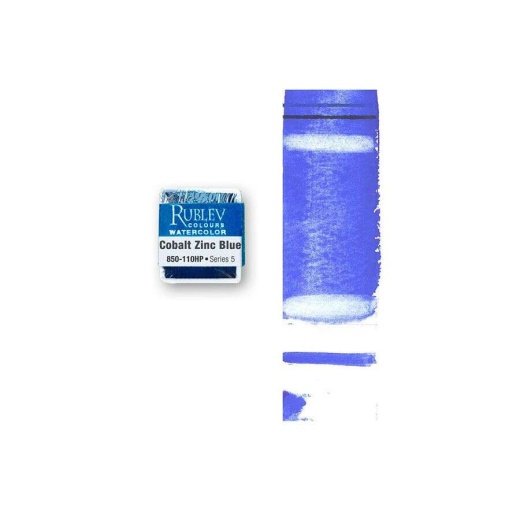
Rublev Colours Cobalt Zinc Blue is a semi-transparent pigment with moderate tinting strength. When it dries, it appears lighter and less saturated. Although pigment particles are very fine, they flocculate, giving a grainy appearance in watercolor. Differences in how the pigment is ground and mixed result in considerable variations in its performance.
What Are Cobalt Blue Pigments?Numerous compounds have been referred to as cobalt blue, and while it is commonly assigned to cobalt aluminum oxide today, many other meanings have been ascribed to this name. Cobalt blue is cobalt aluminate blue spinel (Pigment Blue 28 or PB 28) with the chemical structure CoAl2O4 of which there are three basic modifications (Pigment Blue 36:1, Pigment Blue 36, and Pigment Blue 72), in which parts of the cobalt are substituted either alone or in combination with chromium and zinc. These variations differ in their tinting strength and hue.
| Color | Formula | Color Index |
|---|---|---|
| Cobalt aluminate blue spinel | CoAl2O4 | Pigment Blue 28 |
| Cobalt chromite blue-green spinel | Co(Al,Cr)2O4 | Pigment Blue 36 |
| Zinc cobalt chrome aluminum spinel | (Zn,Co)(Cr,Al)2O4 | Pigment Blue 36:1 |
| Cobalt zinc aluminate spinel | (Co,Zn)Al2O4 | Pigment Blue 72 |
The basic cobalt blue color, Pigment Blue 28, is produced by high-temperature calcination of cobalt (II) oxide (CoO) and aluminum oxide (Al2O4). The variations are produced by partial substitution of the cobalt by chromium and zinc, either alone or in combination with each other. The result is a large variety of cobalt blue pigments that differ in their tinting strength or hues (reddish or greenish-blue), depending on the exact chemical composition. The lighter-colored cobalt blue is prepared by adding zinc (II) oxide to the ingredients used for the basic pigment, forming Pigment Blue 72. Blue-green hues are produced by introducing chromium (III) oxide, which partially replaces the aluminum (III) oxide in the basic cobalt blue, forming Pigment Blue 36.
All of them form the crystalline spinel modification during the calcination process. The spinels are a class of minerals that crystallize in the cubic (isometric) crystal system, with oxide anions arranged in a cubic close-packed lattice, and cations occupying some or all of the octahedral and tetrahedral sites within the lattice. Spinel minerals form octahedral crystals that are usually twinned. They have an imperfect octahedral cleavage and conchoidal fracture. The hardness of spinel minerals is around 8 (chalk has a hardness of 2-3). Their specific gravity ranges from 3.5 to 4.1, and they exhibit a transparency to opacity, with a vitreous to dull luster.
Composition and Permanence| Crimson Ocher | |
|---|---|
| Color: | Blue |
| Binder: | Gum Arabic |
| Additive(s): | None |
| Pigment Information | |
| Pigment: | Cobalt zinc blue |
| Pigment Classification: | Synthetic inorganic |
| Colour Index: | Pigment Blue 72 |
| Chemical Name: | Cobalt zinc aluminate spinel |
| Chemical Formula: | (Co,Zn)Al2O4 |
| CAS No. | 68186-87-8 |
| Properties | |
| Code: | 110 |
| Series: | 5 |
| Opacity: | Semi-Transparent |
| Tinting Strength: | Moderate |
| Staining: | None |
| Granulation: | Low |
| Flocculation: | Moderate |
| ASTM Lightfastness: | I |
| Permanence: | A |
For a detailed explanation of the terms in the table above, please visit .
Note About Separation: Some separation of pigment and medium may occur in Rublev Colours Watercolors. This natural process occurs when no stabilizers are added to the paint to prevent this from happening.
Note About Color Swatches: Color swatches are shown in mass tone, at the top, mixed with an equal amount of water, and brushed out toward the bottom. All color swatch images on this website are approximate representations of the actual colors of the watercolor paint. We have taken every care to match the color in these pictures on calibrated color monitors to the actual color. However, due to the wide variance in color monitors, the results you obtain may vary.