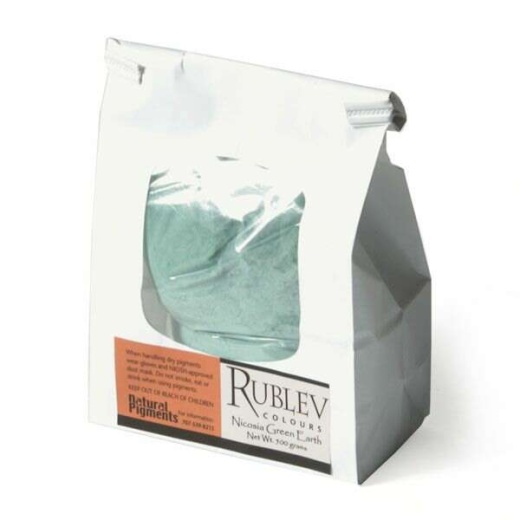
Nicosia Green Earth Pigment is a natural mineral glauconite, a greenish mineral of hydrated iron potassium silicate containing small amounts of aluminum, calcium, magnesium, sodium, and numerous trace elements. It has a bright green color that looks like tiny flakes of the mineral mica or small lumps of clay. The color of glauconite varies considerably from pale green, bright green, bluish-green, olive green, and black-green, depending upon its constituent elements.
Our Nicosia green earth is sourced from deposits in southeastern Cyprus near the region of its capital city, Nicosia. This pigment has been used in painting since ancient times and is known for its vibrant and lasting colors. Restorers have proven through X-ray diffraction that the famous pigments of past centuries known as Veronese and Bohemian terre verte are, in essence, glauconite.
The mineral has a micaceous structure, a silicate crystallized in monoclinic forms that readily separates into very thin leaves. It is characteristically formed on submarine elevations of ancient seabeds ranging in depth from 30 to 1,000 meters (100 to 3,300 feet) below sea level and in the sedimentary rocks of different geological systems. Usually, it forms small (from 0.8 to 1.5 mm in diameter) green round or angular grains.
The preparation of glauconite is usually done with levigation, sifting, and sometimes electromagnetic separation. Sometimes clay or sandy minerals, tinted with aniline red or copper pigments, have been marketed under the guise of glauconite. However, our Nicosia Green Earth Pigment is free from any additives and is completely natural.
Nicosia Green Earth Pigment has good tinting strength and covering power, and the pigment is easily ground. Since it contains some clay, green earth absorbs oil at a moderate to a high rate. It is also considered non-toxic, but care should always be exercised when handling the dry powder pigment to avoid inhaling the dust.