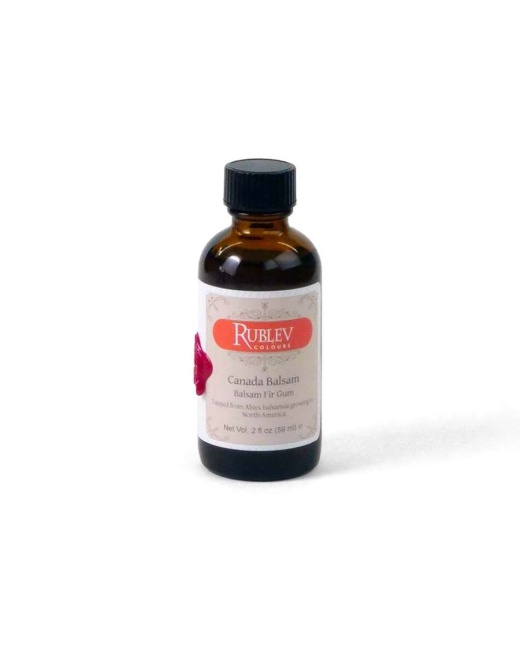
Canada Balsam is the pale yellow oleoresin with a faint greenish cast of the balsam fir tree. It dries to a clear, transparent film. It is used as a plasticizing resin for varnishes and paints. Canada balsam is amorphous when dried. Since it does not crystallize with age, its optical properties do not deteriorate.
OriginThe name “balsam fir gum” is mainly used in North America. In Europe, the product is called “Canada Balsam.” It is also identified as turpentine, fir resin, and fir gum.
Of all the species of fir in North America, the balsam fir (Abies balsamea) growing in Québec and New Brunswick, Canada, is the source of balsam fir gum or Canada balsam. It is a syrupy, greenish-yellow liquid drawn from small blisters on the trunk of the fir tree. Balsam fir gum is harvested between April and November; however, it is typical to harvest in warm weather, as the gum is more fluid during warmer temperatures.
The most common adulterant of Canada balsam is either colophony (rosin) or crude turpentine. The best method of detecting colophony is to drive off the essential oil by prolonged heating on a water bath, leaving the dry resin to be examined. In the case of pure Canada balsam, this dry resin will be found to have an acid value of about 120 to 125, while colophony has an acid value of about 165. Hence, an acid value of over 130 indicates the presence of added colophony or crude turpentine. The presence of these adulterants can, according to E. Dietrich, be confirmed by the Storch-Morawski reaction, but, in the author’s opinion, this is incorrect and cannot be relied on.
There is a product sometimes to be found on the market under the name of “Oregon balsam,” which is not a natural product at all but is a mixture of rosin and turpentine, closely resembling Canada balsam in appearance, and which is used to adulterate it frequently. There is also a true Oregon balsam, which is the oleoresinous exudation from the trunk of Pseudotsuga mucronata. This balsam yields a considerable quantity of essential oil, which can be characterized by its mainly consisting of laevopinene. The factitious Oregon balsam of the above description contains the same proportion of solid resin as pure Canada balsam, and the physical characteristics of the two substances are as nearly as possible the same. However, detecting such adulteration is possible by separating the essential oil and the resin and examining each separately.
Canada balsam closely resembles Strasbourg turpentine in physical properties and composition. Strasbourg turpentine is obtained from the Abies alba, silver fir, or European silver fir and is named after the trading center in Vosges. The Italians called it “Trementina di Strasburgo” or “di Alsazia.” It is a less viscous balsam used historically as a varnish (dissolved in spirits of gum turpentine) to provide special protection to easily decomposed pigments such as verdigris. It was also used as an ingredient in oil varnishes, sometimes to dissolve more insoluble resins such as amber.
StorageTo retain its essential properties, containers of balsam fir gum must be kept closed and stored in a cool, dark place. Canada balsam can easily be kept for several years in this manner.
CleaningTo remove fir gum from clothing, apply strong cleaners, such as Pinesol, Lestoil, or WD-40 spray lubricant, then wash the article as usual.
To clean fir gum from tools, containers, and hands, apply a small amount of vegetable oil, margarine, or butter to the article or hands. These will quickly dissolve the fir gum. Then wash with warm water and soap.
UsesCanada balsam is a plasticizer for varnish and paint. It can be used as varnish when diluted with a small quantity of denatured alcohol, lavender spike oil, or spirits of gum turpentine. The resin can also be mixed with drying oils (linseed and walnut oil) and other resins (copal and damar) dissolved incompatible solvents.
Canada balsam is used to prepare microscope slides and high-precision optical lens assemblies. Balsam fir gum is used for optical lenses because, when dissolved in an equal volume of xylene, its refractive index is almost the same as that of glass.
Packaging2 fl oz, 4 fl oz, and 8 fl oz glass bottles
Former packaging, which may still be available in some locations: 250 mL and 100 mL glass bottles
| Specifications | |
| Physical Appearance: | Pale yellow, viscous liquid |
| Physical Properties | |
| CAS No. | 8007-47-4 |
| Number CE (EINECS): | 232-362-2 |
| Flash Point: | 62 °C (143.6 °F) |
| Refractive Index: | 1.5213 ± 0.0003 (20 °C; method PC-MAT-016) |
| Density: | 0.99 g/mL at 25 °C |
| Acid Value: | 83.3 ± 0.9* mg KOH/g (method PC-MAT-031) |
| Ester Value: | 5.9 ± 0.8* mg KOH/g (method PC-MAT-031) |
| Saponification Value: | 88.6 ± 0.5* mg KOH/g (by calculation) |
| Solubility | |
| Xylene: | One gram is soluble with up to 10 mL of xylene |
| Ether: | 1:1 |
| Toluene: | 1:1 |
| Chloroform: | 1:1 |
| Typical Composition | |
| Volatile Oil: | 20–30% |
| β-phellandrene: | 37% |
| β-pinene: | 36% |
| α-pinene: | 24% |
| α-phellandrene: | 3% |
| Non-Volatile Resin: | 70–80% |
| Abietic and neoabietic acids: | 100% |
*Standard deviation of three samples.
Canada Balsam, while valued for its clarity and adhesive properties, can take a long time to harden, which might be a drawback for time-sensitive projects.
What is the common name for Canada Balsam?The common name for Canada Balsam is Balsam of Fir, as it is derived from the resin of balsam fir trees. It is also sometimes referred to simply as Balsam.
What are the advantages and disadvantages of Canada Balsam?The advantages of Canada Balsam include its excellent optical clarity, good adhesive properties, and natural origin. Disadvantages involve its slow drying time, brittleness when dry, potential for yellowing, and change in refractive index over time.
What does Canadian Balsam smell like?Canadian Balsam has a characteristic pleasant, woody, and slightly sweet scent, reminiscent of the fresh balsam fir trees from which it is derived.
Why is it called balsam?It is called 'balsam' due to its origin from the balsam fir tree and its resinous, balsamic nature. The term 'balsam' generally refers to aromatic, resinous substances secreted by various plants, particularly coniferous trees.